Who This Book Is For
Readers who want OP protagonists who earned it, LitRPG bond mechanics that reward romance, college settings, and the payoff of three thousand years of grinding distilled into one week of forward momentum
Who This Book Is NOT For
Anyone who wants the grinding itself -- this is post-loop by design, so if you need fifty chapters of the MC leveling up from scratch, the premise deliberately skips that phase
Our Review
The Setup
Alex Reid spent 3,247 years trapped in a single Saturday. Over one million cycles. Nearly 250,000 deaths. He mastered 47 languages, 23 instruments, 12 combat styles, and every secret of every person on campus. Then the loop broke. Sunday arrived for the first time in three millennia.
The System that had been silently tracking him across those millennia finally activates. It offers three abilities built on his accumulated experience and a Bond system that transforms genuine emotional connections with women into tangible stat bonuses and shared powers. Five women. Five bonds. One week to build something worth protecting before Phase Two begins.
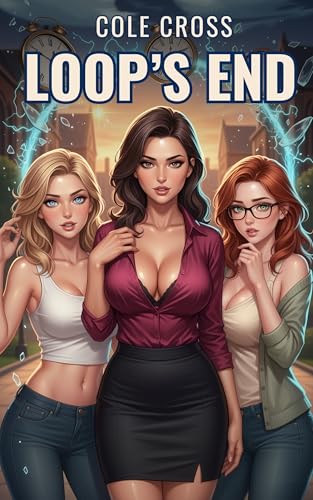
Sophie witnessed the loop break firsthand — the athletic volleyball player becomes his anchor to reality. Dr. Rachel Shaw is the psychology professor he spoke to a thousand times who does not remember a single conversation. Emma is the shy bookworm who writes erotica she has never dared to live. Becca is the sorority queen whose hostility masks something far more interesting. Jess is the tattooed artist who remembers fragments of the loops in her dreams. Each woman offers a different kind of connection, and each connection unlocks different power.
What Works
The premise is a stroke of genius. Most LitRPG harems start with a weak MC and grind him toward power. Loop’s End inverts that entirely. Alex is already the most skilled person alive. His challenge is not getting stronger — it is learning to be vulnerable after millennia of isolation. That emotional flip makes him one of the most compelling harem protagonists I have read this year.
The Bond system is elegantly designed. Each woman has a 0-1000 Bond meter that tracks genuine emotional connection. Thresholds unlock stat bonuses and shared abilities. Sophie’s Bond grants Agility. Rachel’s grants Intelligence. This ties the romance directly to the LitRPG progression in a way that never feels gamey or exploitative. Alex is not farming XP. He is finally playing for keeps, and the System rewards authenticity.
The five women are sharply differentiated. Sophie is competitive and possessive but learns to share. Rachel surrenders the control she wields in lecture halls. Emma transforms from invisible wallflower to someone who demands to be seen. Becca’s hate-to-love arc crackles with tension. Jess’s fragmented loop memories make her the wildcard who changes everything. No two relationships follow the same trajectory.
At 401 pages, this is a substantial read, but Cole Cross’s signature tight prose — twelve to sixteen word sentences, three-line paragraphs, zero filler — makes it fly. On a phone screen, this reads faster than books half its length. The system panels appear at meaningful moments without drowning the narrative in stat dumps.
What Doesn’t
The mystery subplot involving Joseph Summers and the entity behind the loops is clearly setup for future books. It serves the story well as tension, but readers who want full answers within this volume should know the larger mythology is still unfolding. The standalone label means the core harem arc resolves satisfyingly, but the broader conspiracy is a thread left deliberately dangling.
The first two chapters are necessarily interior as Alex processes three thousand years of trauma and the System interface. Once Sophie grabs his arm and demands answers, the pacing locks in and never relents.
The Heat
This is a 5 out of 5 with nine explicit scenes spread across 25 chapters, each one tied to a specific emotional and Bond threshold. The escalation is methodical and satisfying. Sophie’s scenes move from oral to full intimacy as trust deepens. Rachel’s desk-sex scene carries the forbidden charge of a professor finally surrendering. Emma’s first time is genuinely tender in a way that harem books rarely attempt. Becca’s aggressive initiation is rough, competitive, and electric. The FFM scenes between Sophie and Rachel feel earned because Cross spent chapters building their mutual respect.
What sets this apart from most harem heat is that every scene advances both the emotional arc and the LitRPG progression. Bond meters climb. Abilities unlock. The System acknowledges what happened. Sex is not a reward for plot — it is the plot, mechanically and emotionally fused.
Bottom Line
Loop’s End answers a question most LitRPG harems never think to ask: what happens after the grind? Alex earned his power through three thousand years of suffering. Now comes the harder part — trusting five women with the vulnerability he spent millennia burying. The Bond system is the best romance-to-progression mechanic I have seen in haremlit, the cast is distinct and compelling, and Cross’s punchy prose makes 400 pages feel effortless. If you want OP competence that is genuinely earned, LitRPG systems that matter, and heat that rewards every threshold crossed, Loop’s End delivers on all counts. The grind already happened. This is the payoff.
Keep Reading
- More LitRPG harem books ranked by progression and spice
- Progression fantasy harem recommendations
- Best harem books of 2026 — ranked by our editors
- All harem books on Kindle Unlimited
If You Liked This, Try
Both feature LitRPG systems that reward genuine relationship building, but Loop's End trades isekai for a post-time-loop college setting with heavier emotional stakes
Shared OP-protagonist energy where the MC's advantages feel legitimately earned through suffering, though Cross delivers it through millennia of time loops rather than template magic
Similar bond-system progression where connections with women unlock tangible power, but Loop's End grounds its system in a modern college campus instead of a fantasy academy
The Verdict
Loop's End solves the biggest problem in LitRPG harem: how do you make an OP protagonist interesting? By making him OP at everything except the one thing that matters -- building real connections after 3,000 years alone. The Bond system ties romance directly to progression in a way that feels organic, the five women are sharply distinct, and the post-loop premise means every page is forward momentum. Cole Cross writes with the short, clean prose that makes 400 pages feel like 200. This is what competence fantasy looks like when the competence is earned.